A Connoisseur’s Guide to Outsmarting Online Luxury Bag Scams
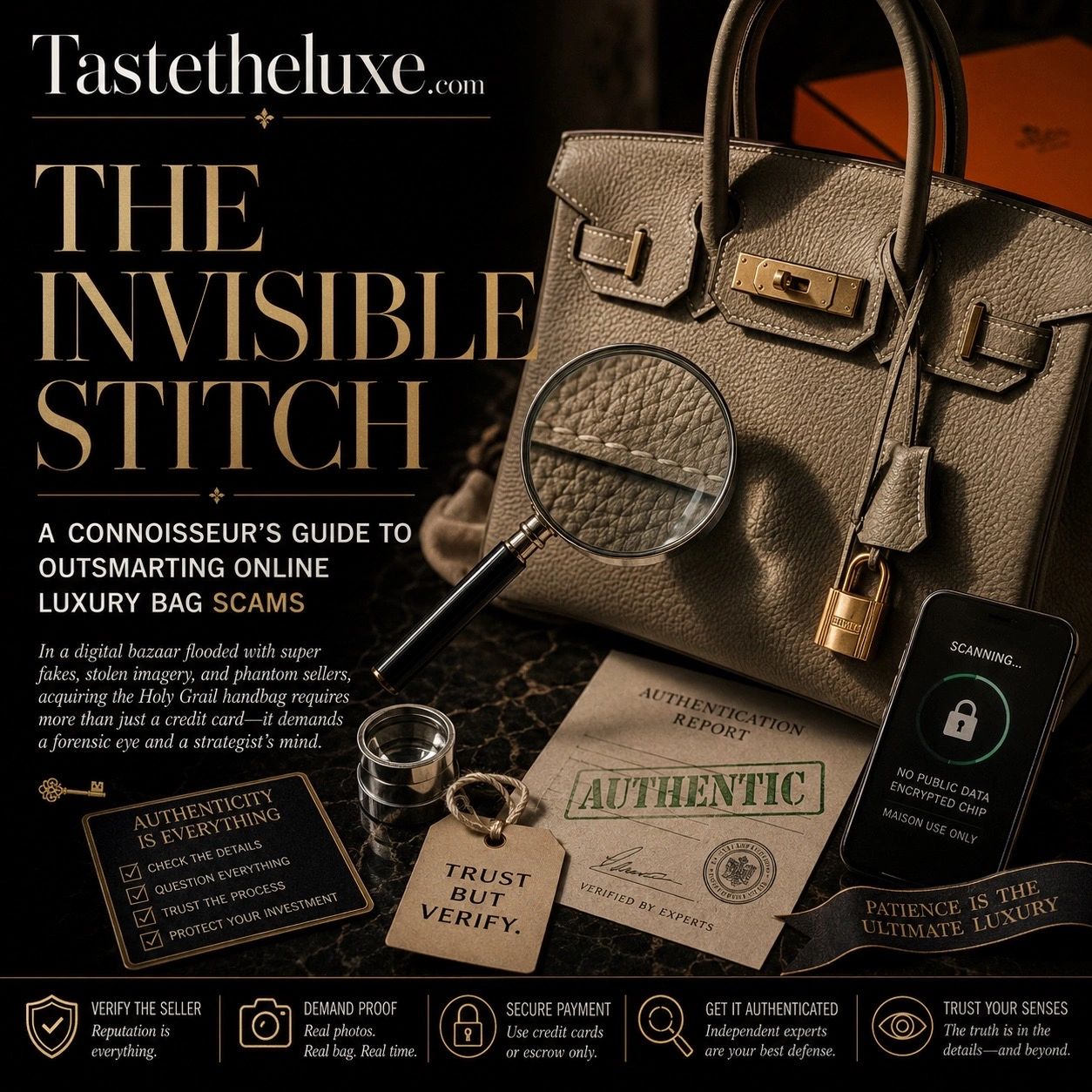
The thrill of the chase is intoxicating. It’s 2:00 AM, the blue light of your screen illuminating your face, and there it is: the Chloé Paddington in that impossible shade of pistachio, or perhaps a Birkin 25 in Vert Amande with palladium hardware that seems to be glowing directly from the depths of a resale app. The price isn’t a bargain-basement steal—you’re too savvy for that—but it’s a whisper below market value, just enough to make your pulse quicken with the dopamine hit of a “smart find.” This is the modern hunting ground for luxury. The gilded boutiques on Madison Avenue and Avenue Montaigne have virtual twins, and the keys to that kingdom are held by algorithms and peer-to-peer marketplaces.
But here is the sobering truth that seasoned collectors whisper over espresso at Barneys: for every legitimate unicorn bag floating through cyberspace, there is a hydra of illusions waiting to devour your investment. The counterfeit industry is no longer a clumsy caricature of crooked stitching and chemical-smelling leather. We are living in the age of the “super fake,” an era where illicit artisans deconstruct authentic bags stitch by stitch, sourcing serial-grade hardware and hide from the same tanneries to create doppelgängers that can fool even boutique-trained eyes. Buying a luxury bag online without a defensive protocol isn’t a purchase; it’s a gamble where the house always wins.
At Tastetheluxe.com, we believe that true luxury is not just about the object, but the security and pleasure of the acquisition. The weight of a Kelly bag on your arm should never be replaced by the sinking feeling in your stomach when an “authenticity guarantee” evaporates. This is not a surface-level checklist. This is your deep immersion into the cat-and-mouse game of digital authentication, designed to wire your instincts so finely that a scam will feel like a vibration in the force before you even click “Buy Now.”
The Puppet Masters: Deconstructing the New Architecture of Deceit
To avoid a trap, you must understand how it’s baited. The days of obvious street-corner knockoffs are a distant memory. Today’s scam ecosystem is a sophisticated, multi-tiered machine, often operating with customer service teams, staged lighting, and a disturbingly keen understanding of the psychology of desire.
The first archetype is the Phantom Inventory Scam. This often occurs on websites that look achingly chic—minimalist design, a Serif font logo, and an editorial aesthetic mimicking Net-a-Porter or Moda Operandi. These sites aggregate stolen images from legitimate consignment stores, social media influencers, or auction house listings. They list bags at a 20-30% discount, the sweet spot where desire overrides suspicion. You pay via wire transfer or Zelle, a pristine order confirmation lands in your inbox, and then… silence. The website vanishes within a week, popping up under a new URL with the exact same inventory—same lighting, same marble background, same ghost.
The second is the Bait-and-Switch Artisan. These sellers thrive on peer-to-peer platforms like Poshmark, Vestiaire Collective, and The RealReal (though the latter has in-house authentication, items occasionally slip through the cracks, sparking heated debate in purse forums). The seller owns the authentic bag. They photograph it lovingly in natural light, a sprig of eucalyptus placed artfully beside it. They have the receipt, the dust bag, the box. But what arrives at your doorstep is a super fake of terrifying accuracy. The scam relies on the buyer’s “post-purchase rationalization” and panic. When you file a claim, the seller pretends to be horrified, accusing you of switching the bag. It becomes a Kafkaesque arbitration nightmare of your word against theirs. Sometimes, they’ve photographed a friend’s bag, or a bag they intend to sell ten times over, sending out ten replicas while keeping the original safely in their closet.
The third is the Emotional Manipulator, a newer breed operating in Facebook groups, Instagram DMs, and WhatsApp. They cultivate a parasocial relationship with you. They share their “personal collection,” commiserate about the waitlists at Hermès, and send you voice notes about the patina on their Box Calf. They are building a bridge of trust to lower your defenses so that when they offer you their “beloved” Chanel Diana because they “need the liquidity for a Patek Philippe,” you bypass standard verification. You trust the person, so you blindly trust the bag. In the world of high-stakes collecting, the seller’s charisma is the most invisible weapon.
The Forensic Geometry of a Listing Photo
Before you analyze a handbag, you must analyze the gravity of the image. A listing photo is a crime scene. We are going to train your eye to look beyond the leather.
Start with the negative space and metadata. Does the background exist in a vacuum? Scammers often strip metadata, but that in itself is a clue. More importantly, a legitimate seller with a $15,000 bag usually has a life. You might see a glimpse of a Josef Hoffmann vase, a Vitsoe shelf, a dog’s tail, the edge of a Wilton carpet. A scammer’s background is often aggressively neutral: a stark white box tent, a generic marble slab, or an unidentifiable blurred greenery that serves as a green screen for countless fake factories. If every photo looks like it was shot for a catalog rather than a person standing by a window, proceed with extreme caution.
Next, demand tactility through imagery. We are looking for gravity. An authentic Birkin, when sitting upright, does not float; it slouches with a specific architecture of relaxation. A rigid, plastic-looking structure in a bag known for supple leather is a tell. Ask the seller to send you a very specific video: a slow-motion pan starting from the bottom of the interior, moving up the zipper teeth, pausing at the point where the leather folds, and ending with a finger pressing into the skin to show how the grain reacts. No genuine luxury leather bounces back like vinyl; it creases like human skin, breathing and shifting. If a seller refuses this “video of intimacy,” claiming they don’t have time or that it’s “too much work,” they are either hiding the bag’s stiffness or they don’t physically possess it.
Now, the hardware cryptograph. The devil isn’t in the details; the devil is in the physics of light reflected by gold plating. Authentic luxury hardware, whether the brushed palladium of Hermès or the 24k gold of Chanel’s vintage pieces, has a depth that electroplated fakes cannot replicate. A fake chain strap on a classic flap often looks yellow and painted, whereas real gold alloy glows warmly, almost internally lit. We call this the “butter glow.” Look at the engraving. Not just the placement—scammers have perfected alignment—but the grain of the engraving. Butter-soft deep stamping versus laser-burned etching. A laser leaves a rainbow-ish burnish on the metal and feels flat; a deep stamp displaces metal, creating micro-ridges that catch your fingernail.
The Unhackable Codes: Date Stamps, Chips, and Stitching Logic
Mythology in the luxury world can be dangerous. “Real bags have five stitches per quilt” is a nursery rhyme scammers already know. We must go deeper into the industrial logic of the maison.
Stitching is a symphony, not a grid.
Look at a high-tier Louis Vuitton counterfeit, then look at the authentic. The thread is the reveal. Authentic LV uses a slightly off-gassing, waxy linen thread that has a subtle golden-wheat color, not a bright chemical yellow. But the real clue is the angle of the saddle stitch. A machine cannot replicate the slight, almost imperceptible slip of a hand-pulled needle entering the leather at a 45-degree angle. It creates a beautiful, minuscule cant to the stitch. Fake stitching lies perfectly flat, uniform to the point of sterility. Perfection is often the hallmark of a machine, and while luxury strives for excellence, it bears the gentle asymmetry of human craft.
The Date Code Debacle.
For decades, the date code was the Holy Grail of authentication, and now it is a liability. Counterfeit units now come with perfectly logical date codes that match the era of the bag they are cloning. The trick is to use the date code not as a stamp of approval, but as a cross-reference for material consistency. If a bag claims, via its code, to be from 1998, the hardware must tell the same story. 1998 hardware had slightly different heft, a different alloy mix, and oxidation patterns that a 2024 bag artificially “distressed” with a chemical bath cannot mimic. A bag cannot have a 1998 date code and 2024-era smell, pocket technology, or dust-bag fabric composition. The dust bag is often the forgotten witness. Modern dust bags are soft cotillion; vintage ones were stiff, scratchy, and often a shade of velour that has changed subtly over decades.
The microchip revolution (introduced by Louis Vuitton and adopted semi-secretly by others) was meant to kill counterfeits. It only evolved them. Now, scammers implant blank chips into fakes. When you scan them with a generic NFC reader, they might trigger a website URL. Danger. The authentic LV chips do not leak a URL to a consumer’s phone; they are encrypted and silent, readable only by the maison’s proprietary internal scanners for inventory management and repair history. If a seller says, “Scan the chip, you’ll see it’s real,” and your phone pings a splashy but slightly off-domain website, you’ve just uncovered a sophisticated attempt at digital forgery, not just physical.
The Psychology of the Heist: Social Engineering Traps in the DMs
We must now talk about the platform where the highest-end scams are festering with a glamorous veneer: Instagram and private WhatsApp groups. This is the “grey market” invisible to Google.
Here, the scam is predicated on the Illusion of Access. A seller presents themselves as an insider—a “personal shopper” stationed outside the Rome atelier or an ex-employee with a friends-and-family discount. Their Stories are a dizzying carousel of rare Himalayan crocodile bags, piles of orange boxes fresh from Sevres, and waitlist offers “available immediately.” The narrative is that they can bypass the system for you.
The red flags here are behavioral. A real personal shopper is a logistical ninja, not a friend. If they over-share emotional drama, discuss their personal money problems, or flatter you excessively (“you’re my favorite client, I saved this specifically for your vibe”), they are grooming you. They are creating a high-stakes emotional environment where saying “no” or demanding a third-party escrow service feels like an insult to the friendship.
Moreover, “proof of life” photos can be faked with a vengeance. You ask, “Write ‘Grace 2024’ on a napkin next to the bag.” They do it. Seems ironclad, yes? No. Modern forgers use digital overlay photography. They have a high-res stock video of a real Birkin, and they digitally superimimpose the handwritten note onto the napkin—or they’ve just printed a tiny napkin prop and placed it inside a super fake. How do you beat the overlay? You don’t ask for a napkin. You ask them to place a specific, three-dimensional object inside the bag with the flap draped down, so it casts a shadow on the leather’s interior. A shiny spoon, a lit tealight candle (showing refraction), or your own name written backward on a crumpled piece of foil. The interaction of light on complex surfaces is almost impossibly time-consuming to fake in post-production. If they get annoyed at these requests, walk away. A genuine seller of a $20,000 bag expects a neurotic, forensic buyer.
Platform Wars: Navigating Vestiaire, The RealReal, and eBay’s Grey Waters
Assume nothing. The “Authenticated” badge is a shield of aluminum, not titanium. Platforms that offer in-house authentication operate on volume and human fallibility. A hungover authenticator processing their 200th Louis Vuitton Neverfull at 4 PM on a Friday might miss the slightly too-bright red edge glazing that signals a counter.
On Vestiaire Collective, where peer-to-peer shipping meets a checkpoint, the danger zone is the direct shipping loophole. If a seller has a long history and a “trusted seller” badge, they can sometimes bypass physical authentication and ship directly to you. Never accept a direct ship from a high-value item, even if it saves two weeks. Insist on full authentication for every transaction. We have seen cases where a trusted seller’s account was hacked and used to sell phantom goods.
For The RealReal, the risk lies not in the obvious knockoff but in the mislabeled condition aided by “creative photography.” A bag listed as “Pristine” might have a shrunken, cracked handle, or a musty, mildew-stained interior that was strategically cropped. The lighting in their studios is designed to sell, not to reveal. You must buy here with a strategy of aggressive returns, and upon receipt, video every single millimeter of the unboxing, because customer service will litigate the return if you can’t prove the damage was pre-existing.
eBay remains the wild west, but its updated Authenticity Guarantee program (where the bag goes to a third-party authenticator before reaching you) has changed the game. However, a loophole remains: the tampered security tag. When an eBay authenticator verifies a bag, they attach a unique, wire-tied security tag. Accept only bags where that tag is fully intact, untampered, and the QR code on it links precisely to the certification page without a single discrepancy in the listed measurements. If a buyer says, “I removed it to give it a conditioning treatment before shipping,” return it immediately. That tag is your chain of custody. Once broken, the bag could be swapped.
The Payment Corridor: No Paper Trail, No Purchase
Luxury is tangible, and your payment method must be equally armored. The language of a scammer is always an attempt to push you into the shadow realm of non-recoverable funds. “We can avoid the platform fees if we use…” This is not a sentence a legitimate seller of a Chanel 2.55 reissue utters. They know that 3-5% platform fees are the price of safety.
The Zelle/String & Venmo Trap:
Never, under any circumstances of a remote transaction with a stranger, use Zelle, Venmo, CashApp, or wire transfers for a luxury bag. These are cash equivalents. They are not designed for commerce; they are designed to pay your friend back for brunch. The banks treat them as authorized push payments, meaning if you authorize a $5,000 transfer to a con artist, Regulation E will not save you. You will sit through a heartbreaking phone call with a fraud agent who will compassionately explain that your money is gone, vacuumed into a burner account and likely already crypto-mixed.
Credit Cards and Escrow Shield:
Your Amex Platinum is not just a piece of metal; it is a private security force. Use a credit card with robust purchase protection and dispute rights. Better yet, for private deals over $5,000, insist on a formal escrow service. It costs a small percentage, but the funds are held by a neutral third party. You receive the bag, you have 48 hours to have an independent authenticator (we’ll get to them) verify it in your hands, and only then does the escrow release the funds. A scammer will recoil at escrow like a vampire from garlic, offering a thousand reasons why it’s inconvenient. A true collector with a genuine artifact will agree, because they are also protecting themselves from a buyer who might do a chargeback scam.
The Independent Umbilical Cord: Professional Authenticators
You are spending thousands. You are not an authenticator. It is time to outsource your anxiety. Services like LegitGrails, Authenticate First, and Zeko Authentication (for Chanel) are your insurance policy. But you must use them correctly. Never rely on a screenshot of a “certificate” sent by the seller, as these are forged as easily as the bag itself.
Here is the protocol we swear by for any secondary-market grail: Pre-purchase, blind authentication. Do not tell the seller you are doing it. Upload the listing photos to the service and simply ask, “Based on these photos, does this look authentic?” Often, a good authenticator can spot a fatal flaw (a font error on a hologram sticker, a structural impossibility in the quilting) from just the listing photos, saving you the agony of a transaction entirely. If the photos pass, you buy the bag with the explicit condition of a physical inspection window. When it arrives, you do not remove the security tags. You photograph your bag intimately and open a full physical evaluation with the authenticator. Only when they issue a physical pass do you cut that tag. That $30–$50 fee is the cheapest therapy you will ever purchase.
Genesis of a Grail: The Scent, The Sound, The Unboxing Ritual
Finally, the box has arrived. You’ve done the digital checks, the escrow is waiting. Before you celebrate, you enter the physical sensory audit. Scammers have mastered the visual, but they chronically fail the chemical and auditory experience of luxury.
The Olfactory Signature: This is the fingerprint that cannot be photoshopped. A brand-new authentic Chanel bag smells of rich, slightly sweet leather with an undertone of a clean, high-end chemical lab—a specific phenol-free curing agent. A fake smells of fish glue, sharp hydrocarbons, or a cloying “new car” faux-leather spray designed to mask a toxic base. Hermès leather, especially in a new bag, smells like a tannery mixed with a fine wood workshop—earthy, complex, deep. Super fakes smell like a PVC shower curtain that was sprayed with perfume. Close your eyes and inhale. If the smell triggers a faint headache or smells “plastic-sweet” rather than “animal-rich,” your skin knows before your brain does.
The Sound of the Hardware: The click of a Birkin’s touret turning, the weight of a Kelly’s sangles sliding, the zipper pull of a Givenchy Antigona… these are engineered sounds. A fake zipper grinds or makes a tinny, high-pitched screech. Authentic luxury zippers (often by Lampo, Riri, or Eclair) close with a fluid, solid, almost hydraulic silence or a satisfying, mellow chunk. Listen to the clink of the two CCs on a Classic Flap clasp. Real hardware has a low, dense resonance like a tuning fork, because the metal is dense. Fake hardware makes a high, hollow “clack” as if two tin cans are tapping.
The Box and the Paper: It sounds mad, but the weight of the tissue paper is a dead giveaway. Luxury houses use thick, pulpy, slightly absorbent paper. Fakes use thin, slick, heavily starched paper that crackles loudly and unnaturally. The ribbon is not just red or black; it’s a specific fiber dye that resists bleeding when touched with a moist finger.
As you pull back that tissue paper, you are not just looking at a bag. You are looking at a monument to the integrity of craftsmanship. The goal of this deep dive is not to make you paranoid; it’s to transform you from a passive consumer into an active gatekeeper. Scammers thrive on the interstitial space between desire and haste. They rely on your willingness to click “Buy” because you are afraid someone else will get there first. The ultimate antidote to the luxury scam is radical patience. The bag that is meant for your arm will survive the 72-hour delay it takes to listen to the hardware, decode the stitching, and interrogate the seller.
In the world of high-stakes collecting, skepticism is the new opulence. Cultivate it, wear it like a second skin, and you will build a collection that carries not just the weight of leather and gold, but the profound, unshakeable peace of the genuine. Happy, safe hunting.